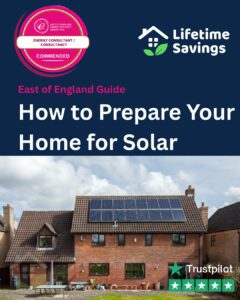
How to Prepare Your Home for Solar
How to Prepare Your Home for Solar
Estimated reading time: 6 minutes
Quick Answer
Preparing your home for Solar starts with understanding your property’s energy efficiency, your roof and any Government support that may be available. Taking a little time to learn about your options now can help you make informed decisions in the future.
More homeowners across the East of England are exploring Solar as a way to improve home energy efficiency and help reduce electricity bills.
If you’re thinking about Solar, you may be wondering where to start.
The good news is that you don’t need to know everything straight away. By checking a few key things about your home, you’ll be in a much better position if you decide to explore Solar further.
Step 1 – Check Your Home’s Energy Performance Certificate (EPC)
Your home’s Energy Performance Certificate (EPC) shows how energy efficient it is.
Properties receive a rating from A (most efficient) to G (least efficient).
If you’re considering future Government energy support, your EPC rating may be important.
If you don’t know your EPC rating, don’t worry. It can usually be checked before making any decisions.
Step 2 – Look at Your Roof
Many homes across the East of England are suitable for Solar.
Things that may affect suitability include:
- The direction your roof faces.
- The amount of roof space available.
- Whether nearby trees or buildings create shade.
- The condition of your roof.
A professional assessment can explain what options may be suitable for your property.
Step 3 – Think About Your Energy Use
Every household uses electricity differently.
Ask yourself:
- When does your family use the most electricity?
- Is someone usually at home during the day?
- Have your electricity bills increased over recent years?
- Are you looking for ways to improve your home’s energy efficiency?
Understanding how your household uses electricity will help you decide whether Solar is worth exploring.
Common Google Question
How do I know if my home is suitable for Solar?
Many homes are suitable for Solar, but every property is different. Factors such as your roof’s size, direction, condition and the amount of shade all help determine whether Solar could be a good option.
Step 4 – Understand the Warm Homes Scheme
The Government has announced plans to improve the energy efficiency of homes through the Warm Homes Scheme.
As details continue to be confirmed, eligibility is expected to depend on a number of factors.
Your home will usually need to:
- Be in England.
- Be privately owned.
- Have an EPC rating of D, E, F or G.
Your household income will usually be £36,000 a year or less.
However, you may still be eligible if:
- You live in an eligible postcode area identified by the Government.
- Someone in your household receives a qualifying benefit.
Current qualifying benefits include:
- Universal Credit
- Pension Credit
- Child Tax Credit
- Working Tax Credit
- Income Support
- Housing Benefit
- Income-related Employment and Support Allowance (ESA)
- Income-based Jobseeker’s Allowance (JSA)
Eligibility will always depend on the Government’s criteria at the time you apply.
Step 5 – Learn Before You Decide
The best decisions are informed decisions.
Learning about Solar now means you’ll better understand:
- How Solar works.
- Whether your home may be suitable.
- How Solar could improve your home’s energy efficiency.
- What Government support may become available in the future.
There is no pressure to make a decision today. Taking time to understand your options is always a sensible first step.
Did You Know?
The East of England is one of the sunniest parts of the UK, making it a great region to explore the benefits of Solar energy.
Ask the Experts at Lifetime Savings Ltd
“I don’t know whether I’ll qualify. Should I still find out more?”
Absolutely.
Many homeowners begin by learning about Solar and understanding the eligibility criteria for Government support. Even if you’re unsure whether you’ll qualify, knowing your options means you’ll be better prepared if funding becomes available.
Frequently Asked Questions
Do I need to know my EPC rating?
It’s helpful. Your EPC rating shows how energy efficient your home is and may form part of the eligibility criteria for certain Government schemes.
Does earning more than £36,000 mean I can’t qualify?
Not necessarily. According to current Government guidance, some households may still be eligible if they live in a qualifying postcode area or if someone in the household receives certain qualifying benefits.
Can the eligibility rules change?
Yes. Government schemes can be updated, so it’s always important to check the latest guidance before applying.
Your Next Step
If you’re preparing your home for Solar, the next step is understanding how Solar could work for your property.
Our next guide is:
Guide 11 – Can Retired Homeowners Benefit from Solar?
You may also find these guides helpful:
- Guide 5 – Is Your Home Suitable for Solar?
- Guide 7 – Do Solar Panels Increase the Value of Your Home?
- Guide 8 – Do Solar Panels Work in the Rain?
Together, these guides will help you build a clear understanding of Solar and how it could fit into your future plans.
Book your solar panel survey today…
Last reviewed: July 2026
This guide is based on the latest Government information available at the time of writing. Eligibility for the Warm Homes Scheme and other Government energy support may change as further details are announced. Always check the latest official guidance before making any decisions or submitting an application.
Solar Panel, Insulation, Heating Grants Lifetime Savings Can Help You Access Government Grants