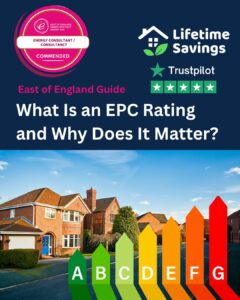
What is an EPC Rating and Why does it matter
What Is an EPC Rating and Why Does It Matter?
⏱️ At a Glance
✔ 4 minute read
✔ Easy to understand guide
✔ Written for homeowners
✔ East of England focused
✔ Trusted advice from Lifetime Savings Ltd
Quick Answer
An Energy Performance Certificate (EPC) measures how energy efficient your home is. Every property is given a rating from A (most energy efficient) to G (least energy efficient). Your EPC rating may be important if you’re applying for certain Government energy efficiency schemes, including the Warm Homes Scheme.
Many homeowners have heard of an EPC, but they’re not always sure what it means.
The good news is that it’s quite straightforward.
An EPC is simply a report that shows how energy efficient your home is and suggests ways you may be able to improve it.
What Do the EPC Ratings Mean?
Every home is given a rating between A and G.
- A – Excellent energy efficiency.
- B – Very good.
- C – Good.
- D – Average.
- E – Below average.
- F – Poor.
- G – Least energy efficient.
Homes with lower EPC ratings often lose more heat, which can lead to higher energy bills.
Why Does an EPC Matter?
Your EPC isn’t just a piece of paper.
It can help you understand:
- How energy efficient your home is.
- Where energy may be wasted.
- Improvements that could make your home cheaper to heat.
- Whether your property may meet the EPC requirements for certain Government schemes.
People Also Ask
How do I find my EPC rating?
If you don’t already have a copy of your EPC, it can usually be found online using your property’s address or obtained when needed during the application process.
Does every home have an EPC?
Most homes that have been sold or rented in recent years will already have an EPC.
Can my EPC rating change?
Yes. If you make improvements to your home, such as adding insulation or installing energy-efficient measures, your EPC rating may improve following a new assessment.
Myth vs Fact
❌ Myth
“My EPC rating never changes.”
✅ Fact
Your EPC rating can change if your home becomes more energy efficient and a new EPC assessment is carried out.
EPC and the Warm Homes Scheme
Current Government guidance indicates that your property will usually need an EPC rating of D, E, F or G to be considered for the Warm Homes Scheme.
Other eligibility criteria are also expected to apply, including household income, qualifying benefits and, in some cases, postcode.
As the scheme develops, Lifetime Savings Ltd will continue to explain any updates in clear, easy to understand language.
Key Takeaways
- An EPC measures your home’s energy efficiency.
- Ratings range from A to G.
- Lower-rated homes may benefit from energy efficiency improvements.
- Your EPC rating may be important when applying for Government energy support.
- Understanding your EPC is a useful first step if you’re considering Solar or other home energy improvements.
Frequently Asked Questions
Is an EPC the same as a survey?
No. An EPC measures energy efficiency, while a property survey looks at the condition of the building.
Do I need an EPC before applying for the Warm Homes Scheme?
Current Government guidance suggests an EPC may form part of the eligibility process. If you don’t know your rating, it can usually be checked.
Can Lifetime Savings Ltd help me understand my EPC?
Yes. We explain what EPC ratings mean in plain English and can help you understand how they may relate to Government energy efficiency schemes.
Still Have Questions?
Many homeowners don’t know their EPC rating until they begin looking at ways to improve their home.
That’s perfectly normal.
Lifetime Savings Ltd is here to make energy efficiency easier to understand, helping homeowners across the East of England make informed decisions without confusing jargon.
Your Next Step
If you’ve been wondering whether there are Government grants available for Solar, our next guide explains the latest position.
Guide 23 – Can I Get a Government Grant for Solar?
Editor’s Note
Last reviewed: July 2026
This guide is based on the latest Government guidance available at the time of writing. EPC requirements and eligibility for Government energy efficiency schemes may change. Always refer to official guidance before making an application.
Solar Panel, Insulation, Heating Grants Lifetime Savings Can Help You Access Government Grants